August 2022
There's a new concentration of power looming in the food system: Big Protein.
The bulk of our protein needs comes from animals, but apparently "animals have just been the technology we have used up until now to produce meat ... What consumers value about meat has nothing to do with how it's made. They just live with the fact that it's made from animals." (Impossible Foods CEO).
Now, it seems, we need to learn to live with the fact that the technology we use to produce 'meat' is shifting from the fields to the factories. That is, to mega-facilities which will extract and purify protein from plants such as soya, wheat, and peas [1], or which will brew animal muscle cells in giant vats [2]; or which will grow bacteria in huge bio-fermenters [3]. The missing meat-like qualities, such as taste, micro-nutrients, texture, fat and blood will be produced in supporting factories. Indeed, "A radically reshaped future is rushing towards us" (Fassler).
If all this sounds like a niche market for wealthy, middle-class animal-lovers who don't mind how processed their food is so long as it doesn't make them feel guilty, be assured that there are big players who expect Big Protein to be a big game.
Showing posts with label meat. Show all posts
Showing posts with label meat. Show all posts
The patent mania of big protein

Fake meat: real pressure on government
August 2022

Make no mistake, your government will be under a lot of pressure to jump on the fake real 'cultured' meat bandwagon [1]. Westminster won't risk being seen as an old-fashioned, backward-looking government, scared to grasp the lab-meat nettle while other governments race ahead.
Fake real meat is being presented as inevitable by companies planning to market it. GOOD Meat, for example, is confidently predicting that its product "will replace conventional meat at some point in our lifetimes" as "consumers increasingly recognise the environmental impact of their diet choices and search for healthier and more sustainable products".
Who benefits from alternative proteins?
August 2022
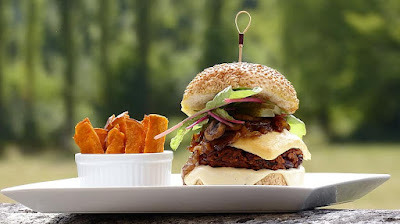
What problem is the burgeoning market for alternative proteins from plant-based meat [1] and cell-based meat [2] trying to solve?
Manufacturers of imitation meat stress that their product is one we can "feel good about". It's healthier, it will solve the rising protein needs of our increasing global population, and it will save the planet from the crippling effects of our unsustainable, greenhouse gas-gushing food system.
The problem presented is the need for more protein-rich food at the same time as the need to reduce the greenhouse gases produced by meat production. We can only solve this contradiction by building factories for mass-produced plant-based and cell-based meat substitutes.
Or, are we being lead up the garden path?

Manufacturers of imitation meat stress that their product is one we can "feel good about". It's healthier, it will solve the rising protein needs of our increasing global population, and it will save the planet from the crippling effects of our unsustainable, greenhouse gas-gushing food system.
The problem presented is the need for more protein-rich food at the same time as the need to reduce the greenhouse gases produced by meat production. We can only solve this contradiction by building factories for mass-produced plant-based and cell-based meat substitutes.
Or, are we being lead up the garden path?
Fake real meat - or a bunch of hooey?
August 2022
The latest food-like substance trying to transition from the laboratory to the factory, and hence to our dinner-plates, is fake real meat. That is, real animal cells, whose many-times-great grandparents were part of a real animal and which have been persuaded to multiply themselves in a great big tank, are squished together to make pretend mince-meat.
A better class of fake requires that the cells are exercised on a mini-muscle-gym to make them develop physically more like the real thing, and a scaffold for the cells to grow on to give them a muscle-like shape and texture.
Fake real meat is also known as 'lab' meat, 'cell' meat, 'cultured' meat, 'vat-grown' meat, 'lab-grown' meat, 'lab-cultured' meat, 'in-vitro' meat, and oddly 'cultivated' meat (although ploughs and weed-suppression do not feature in its production).
The latest food-like substance trying to transition from the laboratory to the factory, and hence to our dinner-plates, is fake real meat. That is, real animal cells, whose many-times-great grandparents were part of a real animal and which have been persuaded to multiply themselves in a great big tank, are squished together to make pretend mince-meat.
A better class of fake requires that the cells are exercised on a mini-muscle-gym to make them develop physically more like the real thing, and a scaffold for the cells to grow on to give them a muscle-like shape and texture.
Fake real meat is also known as 'lab' meat, 'cell' meat, 'cultured' meat, 'vat-grown' meat, 'lab-grown' meat, 'lab-cultured' meat, 'in-vitro' meat, and oddly 'cultivated' meat (although ploughs and weed-suppression do not feature in its production).
Cancer burgers in bacterial buns
November 2021

We're in a mess.
Our climate's crumbling and our ecosystem's in collapse.
Human 'progress' has become a one-way street, in which we're leaving a trail of devastation behind us and facing ever-more bleak views ahead.
In fact, we appear to be digging our own grave, and don't seem to know how to stop.
Bogus bleeding beef
August 2019


Remember the bleeding GM veggie-burgers
rolled out across America in 2017? That's the fake meat produced by
a similar method to the way Belgian beer's been made for nearly a
thousand years? [1]
The Impossible Burger arrived courtesy
of $80 million worth of research plus $300 million worth of promotion
from foodie celebrities, and a heap of hype. Breathless write-ups
name the Impossible Burger this year's 'It' food craze taking America
by storm, and a wake-up call to the meat industry.
Indeed, the long-term goal of the bogus
burger's manufacturer, Impossible Foods Inc., is to disrupt the meat
industry and convert meat eaters to their products. Impossible
Burgers are set to be followed by Impossible Sausages for pizzas and
Impossible Steak.
Too much trade is bad for you
July 2018

Once upon a time, trade was a mutual give-and-take which promised lasting prosperity for both partners; and with prosperity would come well-being.
The modern way redefines 'prosperity' in terms of ever-expanding trade whose boundaries are global. Now, 'trade' has winners and losers, and the 'well-being' part is nowhere.

Once upon a time, trade was a mutual give-and-take which promised lasting prosperity for both partners; and with prosperity would come well-being.
The modern way redefines 'prosperity' in terms of ever-expanding trade whose boundaries are global. Now, 'trade' has winners and losers, and the 'well-being' part is nowhere.
Impossible bleeding burgers
September 2017
 'Synbio', a.k.a. synthetic biology or synthia, began to look like becoming a reality in our food in 2014. Natural artificial additives such as stevia, vanilla and saffron look-alikes produced in vats of GM yeast were set to hit our plates [1].
The following year, 'Muufri' cowless milk emerged. Muufri has six key natural artificial cow's milk proteins produced in vats of GM yeast [2].
One year on, 'Soylent' meal alternatives became the must-have for the modern man who doesn't have time to shop, cook or sit down to eat. Soylent is "proudly made with GMOs" and doesn't even pretend to have any natural ingredients [3].

The following year, 'Muufri' cowless milk emerged. Muufri has six key natural artificial cow's milk proteins produced in vats of GM yeast [2].
One year on, 'Soylent' meal alternatives became the must-have for the modern man who doesn't have time to shop, cook or sit down to eat. Soylent is "proudly made with GMOs" and doesn't even pretend to have any natural ingredients [3].
Food industry: anything left to trust?
March 2013

The public response to finding it was eating horse was to take evasive action. Plastic-enshrouded
'beef' in supermarkets was spurned in favour of the traditional
skills of the local butcher. Shoppers diverted away from frozen
ready meals to prepare their own from scratch. In other words, the
oft-stated consumer demand for cheap food (the justification
for our current mass-produced, over-processed food supply) was shown
to be a myth. And the claim that only the middle classes worry
about what's on their plate, has also been blown out of the water.
Customers across the board were very quick to stop buying cheap food
when that 'food' was revealed to be untrustworthy.
Other healthy outcomes to have emerged
from the horse-meat fiasco include consumer demand for transparency,
for shorter supply chains, for traceability, and for labelling
accurate enough to allow them to choose British.
The curious tale of the horse that became a cow
March 2013
As the horse-meat-sold-as-beef scandal runs and runs, one thing is clear. The gap between what we understand as 'food' and what we're actually being sold is uncontrolled and uncontrollable.
The tale started as a mad maze of
international intermediaries shuffling papers to which a lump of meat
was loosely attached. ...
Put pressure on Morrisons
April 2012
Morrisons supermarket has dropped its GM-free feed requirement for poultry produce.
The reasons it gives seem to be three-fold.
One, is that the move will take some pressure off farmers, by which Morrisons seems to mean the pressure of the higher cost of non-GM feed. As GM Freeze has pointed out, the supermarket's acceptance of cheaper feed is likely to lead to a drop in the price it will pay farmers rather than, as Morrisons hint, any benefit. Sceptics might suggest that the pressure on farmers is due to the supermarket's refusal to give them a fair price for their poultry products.
 |
| Entrance to Morrisons. Photo by mattingham on Flickr |
The reasons it gives seem to be three-fold.
One, is that the move will take some pressure off farmers, by which Morrisons seems to mean the pressure of the higher cost of non-GM feed. As GM Freeze has pointed out, the supermarket's acceptance of cheaper feed is likely to lead to a drop in the price it will pay farmers rather than, as Morrisons hint, any benefit. Sceptics might suggest that the pressure on farmers is due to the supermarket's refusal to give them a fair price for their poultry products.
McClones
July 2011
Cloning animals isn't strictly a GM-food issue. However, it does involve removing DNA from its native environment and putting into a new one, with all the same, inevitable, disruption of genomic coherence and compromised health (see Nuclear Transplant (Cloning) below). There's also no doubt that the major incentive for cloning animals is that the procedure enables genetic transformation.
 |
| Photo © Greenpeace / Christian Lehsten |
Subscribe to:
Posts (Atom)