Pages

Showing posts with label mosquitoes. Show all posts

Scientific mindsets clash over GM mozzies

February 2020


At the end of last year, GM-free Scotland reported a study which found a significant presence of offspring of Oxitec's GM 'sterile' male mosquitoes flying around in areas of Brazil where a trial release had been carried out [1]. The object of the trial was to prevent dengue virus by eradicating its mosquito vector. The predicted "barrage of attempts to discredit the scientists and their science which seem to have become routine in response to any biotech-unfriendly research results" duly unfolded.

No surprise there, except that the attack on the study, including a demand for retraction, was led by one of the paper's own co-authors and supported by five of the others.

Mozzies ride the wind

January 2020


Efforts to control mosquito-borne diseases, such as malaria and dengue virus, have focused on eliminating the vector. Long-standing mosquito control methods have involved insecticides and removing the open bodies of water necessary for breeding. More recently, releases of GM sterile males [1], GM fungal pathogens [2], and self-destruct gene-drives mozzies [3] have been trialled.

Yet, paradoxically, even in areas where extreme reductions in the mosquito population have been successfully maintained, and even in areas where the surface water, vital for breeding, is absent for three to eight months of the year, malaria persists.

GM mozzie ethics wanting

November 2019

Manufacturer of GM insects, Oxitec, seems to have had little difficulty persuading Brazilian regulators to approve the commercial release of its first-generation, 'male sterile' GM mosquitoes intended to control the spread of Dengue virus. 

GM mozzies out of control?

November 2019


GM 'sterile' male mosquitoes are designed to breed with natural, native females, but fail to generate viable offspring.  In theory, these GM insects are supposed to control the mosquito-borne spread of viruses, such as Dengue fever, by suppressing their vector.  

However, a study has been published showing a "significant" emergence of hybrid, GM-strain/native, mosquitoes in a Brazilian city after releases of Oxitec's 'sterile male' GM mosquitoes.   

Super fungus bites mozzies

October 2019

The mosquito has a reputation for being "the most dangerous animal in the world" credited with killing "one million people a year" (Bates). 

Actually, it's unlikely any mosquito has ever killed anyone, but several very nasty human pathogens have seized the opportunity of hitching a ride from person to person inside biting mosquitoes.

Mosquito-born disease isn't just a developing world problem. Fifty-two Scots were diagnosed with malaria in 2018 after travelling abroad. One of them died.


The rosy face of gene drive organisms (GDOs)

February 2019

Much attention has been focused on gene drives to eliminate mosquitoes plus all the horrible diseases they carry [1], and to eliminate invasive small mammals plus all the havoc they wreak in foreign ecosystems [2]. The take-home message is that gene drives can be harnessed for the common good as invaluable tools in medicine and conservation.

Odd really, because the patents filed for gene drives are largely for agricultural applications.

Outside the media radar lie plans to eliminate insect pests and weeds, plans to speed-breed GM seeds and higher-yielding GM livestock, and even plans to convert whole bee colonies to a GM form which can be directed by light beams to the required crop needing pollinated, and plans to create GM locusts which don't swarm.

Gene-driven pollution

February 2019

When the notion that "site-specific selfish genes" (able to copy themselves into a particular target DNA sequence) suggested the possibility of gene drives, a technique to rid the world of malaria immediately presented itself. The author who described this warned that the technology "is not to be used lightly, and that containment issues and the desirability of eradicating or genetically modifying a wild species "ought to be addressed during development" with "wide-ranging discussions".

Then came CRISPR [1], which can be designed to target any desired section of host DNA to bring about any desired molecular alteration there, and can be coupled to a gene drive.

Mind the mozzie gap

February 2019


Mosquitoes can't bite you to death. In fact, half of them don't bite at all: only the females have a blood lust, and that's only when they're incubating eggs. Even then, most often, they'll home in on some other warm-blooded, non-human blood source.

Nevertheless, the opportunistic viruses and parasites able to hitch a ride from person to person in a mosquito kill some 850 thousand of us each year.

Forward-looking FriendlyTM mozzies to beat malaria

August 2018

Earlier this year, the World Health Organisation (WHO) declared Paraguay officially free of malaria after zero recorded cases in five years. Algeria, Argentina and Uzbekistan are on track to be declared malaria-free later this year.

As the head of the WHO said, the importance of this success story is that it shows what is possible: "If malaria can be eliminated in one country, it can be eliminated in all countries".

The problem with malaria is that, although it can be eliminated locally by wiping out the mosquitoes which harbour it and treating its victims so they don't pass the disease on, the mozzies and their parasites will always come back. Human beings will visit malarial regions and return with infections, mosquitoes will fly in from neighbouring infected areas, and both the flies and the parasites will evolve resistance to the chemicals designed to kill them. All this means you have to keep on the case.

Gene driven mutations

November 2017


Gene drive technology could soon become the much needed "self-sustaining, species-specific and affordable" means of eradicating horrific diseases, such as malaria, by wiping out the insect vector upon which the spread of the pathogen depends [1].

Current research is focusing on wiping out mosquitoes by giving them a gene drive with a 'nuclease' enzyme which will disrupt the function of a key mosquito gene needed for fertility in the females: by creating successive generations plagued by sterile females, the mosquito population and the disease will be decimated.

With a generation time counted in days and little tendency to fly very far during their short lives, the gene drive is predicted to be very rapidly effective in the area where the GM mosquitoes are released.

This sounds like a win-win situation (for humans), but is it that straightforward?

Florida GM mosquitoes will not be released

January 2017
Photo Creative commons
The first ever mass release of GM mosquitoes in the U.S. will NOT go ahead.

Not wanting to be used as lab rats forced to swallow, breath and be bitten by biotech mozzies in their own homes, the Florida community chosen to be the subjects of this reckless, real-life experiment complained very loudly.

The US Food and Drug Administration (FDA), which had fast-tracked approval of the trial release of Oxitec's self-destruct GM mosquitoes, simply hadn't done its homework.  There have been no impact assessments on people, nor on threatened and endangered species, nor on the environment, nor even on the Zika virus and Dengue virus the high-tech decimation of the mosquito population is supposed to achieve [1].

Any future applications for GM mosquito release will require an 'Environmental Assessment' and a 'Finding of No Significant Impact'.

Gene drives or gene bombs

September 2016
Photo: Creative Commons
Earlier this year, the latest and most sinister variant of genetic engineering yet, the gene drive, hit the headlines [1].

When artificial DNA is linked to a gene drive in a plant or animal, it will engineer any DNA it pairs up with and create a genetic change which is passed on to 99 percent of the offspring. The GMO version will rapidly become ubiquitous in the population.

Oxitec business

September 2016
Photo: Creative Commons
From its August beginnings as a commercial spin-off from Oxford University's Innovation management subsidiary, 'Oxitec' self-destruct GM mosquitoes have never quite fulfilled early expectations.

Even the rosy vision of an end to major world killers like malaria, and dengue fever didn't manage to sell Oxitec mozzies.

However, Zika virus with its horrific connections to birth defects, provided a much better PR platform to generate the will to spend cash and annihilate mosquitoes at any cost [1].

In the meantime, the rights to Oxford's GM mozzies have been sold into the tender care of US-based Intrexon Corporation, and continue to be mired in controversy.

Zika and super-zika

April 2016

One of the big health issues to emerge in 2016 is the Brazilian epidemic of babies tragically born with 'microcephaly' (undeveloped brain) and other deformities.  Between October 2015 and January 2016, some 4,000 cases of malformation were reported, with 49 deaths.  Health officials were quick to blame Zika virus which had been first identified in Brazil in April/May 2015.

Gene driven insects

April 2016

Not content with Nature's measured pace for adjusting the genome to suit the ecosystem, the environment and the future, genetic engineers have devised a way to force GMOs to add an extra copy of artificial DNA into their offspring.  This creates a mutagenic chain reaction which drives the artificial DNA progressively into subsequent generations.

The 'gene-drive' is based on a bacterial genome-editing technique described by GM-free Scotland before - CRISPR-Cas9 [1].  'Cas9' is an enzyme which cuts DNA, while the 'CRISPR' part is a homing device to anchor the Cas9 to the desired bit of the genome.  In a gene-drive, the CRISPR-Cas9 stays where it is in the genome and carries on mutating the genome of the wild-type mate during reproduction to produce nothing but mutated offspring.

This means that what genetic engineers can do now is population engineering, and if applied to wild populations this is ecological engineering.

GM salmon approved

January 2016
In November 2015, after nearly two decades in the regulatory pipeline, the biotech creators of GM fast-growing salmon were "delighted and somewhat surprised" when the US Food and Drug Agency (FDA) finally approved their novel fish [1].

Labelling requirements have been left vague, limited to draft guidelines on wording for possible voluntary 'GM' or 'non-GM' labelling.

GM mosquito tricks get cleverer

September 2014

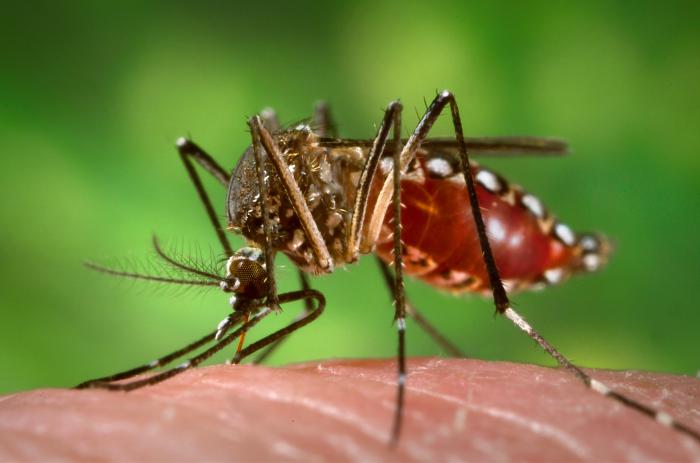
Close up of a mosquito on human flesh
Aedes aegypti mosquito. CC photo by Sanofi Pasteur on Flickr
Mosquitoes aren't human food. But humans are food for mosquitoes.
 
As mosquitoes feed off you, they inject saliva into you to keep their food (your blood) flowing out. During this, they can also transmit diseases such a malaria and dengue, and the latest thing in GM mozzies can also give you a dose of destructive DNA. 
 
Natural mosquitoes are part of a serious health problem. GM mozzies could be much worse.

Operation exterminate mosquitoes

April 2012
Female Aedes aegypti mosquito
By James Gathany [Public domain], via Wikimedia Commons
'Dengue fever' is an illness caused by a virus which is transmitted from person to person by biting female mosquitoes belonging to the species Aedes aegypti.

Infection can lead to a full continuum of disease: the symptoms are 'flu-like, but are rarely fatal and up to half of cases are asymptomatic; Dengue Shock Syndrome and Dengue Hemorrhagic Fever are potentially life-threatening; the latter is seen most often in children and causes death in 5% of cases.

The focus of control of dengue is to eliminate the mosquitoes which carry the virus and so break the cycle.

To this end a UK biotech company, 'Oxitec' (see below), has created self-destructing GM mozzies.